
Transformative Civilizational Leadership
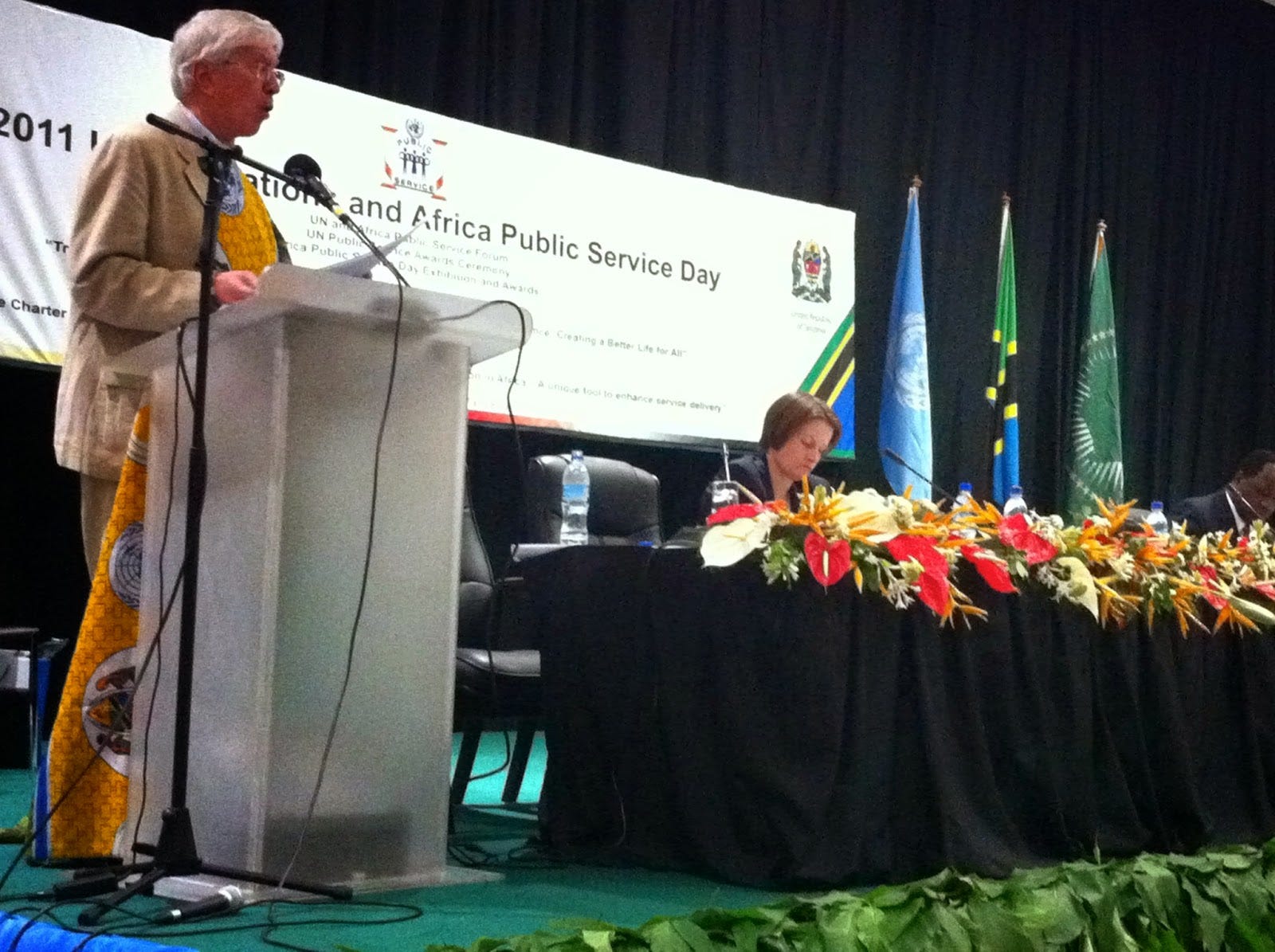
On 20 June 2011 I gave a plenary presentation to 600 participants from around the world attending the UN and Africa Public Service Forum held in Dar es Salaam, Tanzania. The text of my speech on "Transformative Leadership for Sustainable Human Development" follows.
------------------------------------------------
Jambo! Habari?
I am very happy to be with you. Why are we here – in Africa, in this gathering? I have returned to Mother Africa, East Africa, as a pilgrim to the birthplace of the human species. I am part of this gathering because I am convinced that you and I can make a difference in this glorious, suffering world by what we think, say and do.
What is a human being (binadamu), born here in East Africa? What is development? What is human development? What is the purpose of societal organization and governance in relation to human development?
These are urgent, practical questions facing us as a species. Our responses to these questions, both in our individual thought and behavior and in our collective culture and systems, will determine how human society and all life forms flourish or decline on planet Earth.
There are many views of what a human being is; and each definition of humanness carries within it an implicit or explicit definition of development. In the view of the United Nations and the international community, a human being is one who is guaranteed universal rights by society as articulated in the Declaration of Human Rights. Over the past twenty years the UN has analyzed and promoted “sustainable human development.” Furthermore, the Millennium Development Goals were agreed upon to provide tangible targets for human development over the short term.
How do nations and local communities understand the social compact that guides the design of social systems for the benefit of all human beings, all living beings and the finite resources of planet Earth including plants, animals, water, soil and air? Based on the Universal Declaration of Human Rights, the social compact directs that human beings agree to care for each other to ensure that each person has the necessary conditions for a full and meaningful life while ensuring that future generations have the same right.
This means that in order for all people to enjoy these rights, no group of individuals should make this impossible by the over accumulation of economic wealth, political power or cultural dominance.
I believe that we have just entered the Most Critical Decade in human history – a time to do what is needful or face the direst of consequences. Other generations thought they were it; they were wrong; we are it. If we do the right things, the future of life on Earth can be brighter than we can imagine. If we don’t, the future could be dismal and even disastrous. (Turn to a person near you and share in one minute each what for you is the greatest crisis and opportunity that humanity faces today.)
We are in the midst of a whole systems transformation – a time of chaos, crisis and possibility. We are facing multiple, interlocking crises including climate chaos, economic injustice, increasing poverty, dysfunctional governance, gender inequality, unsustainable energy and an HIV/AIDS pandemic. Each of these crises, however, is also an unparalleled opportunity for the reinvention of the human enterprise.
We as a global society have the tools and technology needed to solve each of these crises. What we lack is collective agreement and action. We must, at the same time, transform individual consciousness and behavior and collective culture and systems.
These crises are an opportunity to reinvent nothing less than human society itself from the bottom up, the top down and the inside out based on principles of sustainability, equity, justice and participation. We can literally create a world that works for everyone – societies that enable each person to realize her or his full potential.
There is a pathway forward. We need to put an end to our purely production-consumption society, end the unrealistic concept of unlimited growth and drive towards a sustainable, equitable, participatory, just society. We need renewable energy, an equitable financial system, participatory governance, gender equality, environmental protection, universal healthcare and education for all. We need new ways of thinking, new assumptions, and new myths, policies and collective action. We need to understand how to stay awake and how to act mindfully. We need a “lure of becoming” that draws us out of the present delusion and morass toward a hoped-for future.
Within this very moment of crisis, a new civilization is emerging. It is an Earth-based civilization. In this new civilization, people will increasingly embody a consciousness of being part of the living Earth, of being part of the life force of our beautiful planet. (Look back from the Moon and see the blue Earth in black space.) We are all Earthlings. All people and all life forms are our brothers and sisters. We have a common future or no future at all. In the new civilization, people will embody behavior that is empathic and compassionate. People will embody a culture of peace, creativity and learning. People will embody systems, policies and institutions of equality, justice, sustainability and universal participation in decision-making. And if we do not create such a civilization, the alternative will be chaos, tyranny, suffering and systems collapse.
In the midst of this critical decade we must build a new civilization of sustainable human development country by country, organization by organization, community by community.
We are here together in the UN Public Service Awards Forum to celebrate successes and challenge ourselves to create a new civilization lesson by lesson, story by story. We are here in Dar to advance that noble cause. Public service in the 21st century faces many challenges and opportunities. In the midst of the breaking down of an old civilization and the emergence of a new civilization, public service is now called more than ever before to provide innovative leadership for sustainable human development.
There are many styles of leadership which follow a developmental progression identified by Dennis Emberling. First, leadership can be authoritarian, exploitative and coercive with the leader as the boss, dictator or employer. Next leadership can be bureaucratic with the focus on rules and roles with the leader as a manager, administrator or “parent.” The third stage of leadership is pragmatic with a focus on results with the leader as a guide. Next, leadership can be based on values and principles with the leader as a facilitator, coordinator or coach. And finally, leadership can be systems-based with a concern for multiple perspectives with no managers but true delegation of responsibility to all members of the team.
What then are the most effective means in this critical decade with which to build a new civilization? Transformative leadership approaches are keys to unlock our human potential. I would like to share with you three of the most effective methods of transformative leadership.
Change requires new systems, policies and institutions but these alone are not enough. In order to create effective change, we must also transform individual consciousness and behavior and collective culture. These four dimensions of leadership based on Ken Wilber’s quadrants of integral development are all essential: change that is both individual and collective and internal and external.
Within each of these quadrants of leadership we must work on four levels of
transformation: physical/sensory, psychological/historic, mythic/symbolic and unitive/spiritual. These four levels as delineated by Dr. Jean Houston in her social artistry work are all essential for creative, effective change to take place.
The third set of methods that is part of innovative leadership is the Technology of Participation or ToP. This array of effective leadership methods was developed by the Institute of Cultural Affairs (ICA.) ToP includes, among others, methods of effective group discussion, group workshops and strategic planning.
These and similar methods will help us catalyze a new civilization in this critical decade through public service, public administration and governance. If a leader makes use of these types of innovative methods, whole organizations, institutions and communities will begin to mirror and emulate the leader’s own awareness and prowess creating a powerful multiplying effect throughout the society. Can you imagine the use of transformative leadership approaches in a cabinet meeting, a parliament, a civil service bureaucracy, a corporate board room or an NGO meeting and what a difference they could make?
Transformative leadership moves a society from a past-oriented problem-solving mode to a future-oriented whole systems design mode. It helps transform individual mindsets, values and behavior, and collective culture and institutions. The transformative leader is deeply concerned and committed to creating the conditions in a society that enable each woman, man and child to realize her/his full potential. Transformative leadership makes use of participatory, interactive methods to ensure that each person’s voice and wisdom is heard and felt in social dialogue and policy making. The transformative leader is a social artist and makes use of myths, stories, rituals, symbols and metaphors to motivate the society to imagine and reach its future vision.
Transformative leadership makes use of the very latest information technologies to enable the population to participate in governance processes at every level. The transformative leader is a person of deep personal integrity and empathy who manifests compassion for other people. He/she is committed to being the servant of the people in helping everyone to live well. Transformative leadership is responsive to present and potential dangers and disasters and helps prepare and engage the population in doing what is needed to avert and deal with natural disasters such as climate chaos and human-made suffering such as armed conflict. The transformative leader has a profound belief in universal human rights and is a powerful advocate for the empowerment of women, minorities, elders and youth.
Transformative leadership works to create strong, accountable and transparent democratic institutions and processes of governance. The transformative leader does everything in her/his power to help make a better life for all the people. In order to do this, he/she spends over half of her/his time managing his/her own ego, pride, greed, fear, anger and hatreds and practices concern for and understanding toward all people.
Following the Forum we the participants will return to our countries, organizations and communities with renewed vision and practical tools for the betterment of our societies.
We will stay networked electronically and will continue to challenge and encourage each other. We will make use of new methods of leadership and will help create new institutions of participatory governance. We will design new systems and structures, as well as new policies, programs and projects that will put into practice the insights gained in the Forum. We will continue to transform our own consciousness, values and behavior as we help others transform theirs. We will catalyze new cultures of mutual respect and understanding among all people everywhere.
What if these four days in Dar marked a turning point in human history - from despair to hope, from greed to compassion, from impoverishment to empowerment? What if We the Participants are indeed the people that the world has been waiting for? What if we are the catalysts and servants that history requires at this time? What if we are able to mobilize people in such a way as to respond to climate chaos, increasing poverty, dysfunctional
governance, the HIV/AIDS pandemic, gender-inequality and economic collapse? What if we embody integrity, creativity, effectiveness, accountability and transparency in everything we say and do?
What if we are the transformative leaders who call our fellow and sister citizens to join us in the greatest and noblest of tasks – to Build the Earth - to create a New Civilization - to catalyze Sustainable Human Development? What if these are indeed the times and we are indeed the people? What if we have come to East Africa to be reborn as truly human beings?
Asante sana!