
Public Administration Capacity Building
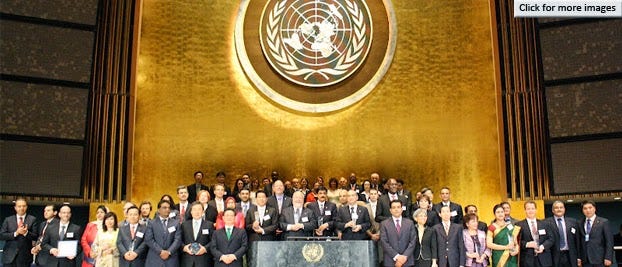
Summary of my paper for the UN Economic and Social Council, "Strengthening Governance and Public Administration Capacities for Development."
----------------------------
“From time to time, one sees the possibility of the world as it could be, where each of us has the opportunity to live life fully and to have our lives make the kind of difference we want to make. Focusing our attention, daily and hourly, not on what is wrong but on what we love and value, allows us to participate in the birth of a better future, ushered in by the choices we make each and every day.”
- Nelson Mandela
How can public administration and development practitioners better engage in governance and development to relieve human suffering, protect the Earth’s fragile ecosystems and reframe societal goals for peace and progress? It is now understood that institutional and human capacities, governance and development are interdependent and in a relationship of mutual cause and effect.
In this time of radical transformation and crisis, a new generation of governance and public administration capacities is needed to achieve sustainable, people-centered, pro-poor governance and development. This includes abilities to think and act comprehensively and in consideration of future generations, effectively and collaboratively, ethically and with self awareness, creatively and courageously and in the collective interest and in stewardship of the global commons.
Governance and public administration capacities are needed to design and develop systems, institutions and policies; facilitate effective organizations, networks, teams, communities and projects; reinterpret cultural values and stories and recreate national vision and social communication; and enhance individual awareness, values and practical skills.
Capacity challenges are faced by each governance and public administration institution in relation to the internationally agreed development goals, including the MDGs, with special challenges present in countries responding to rapid system change and trauma. Assessment of current capacities needs to be carried out in an inclusive and participatory manner and become the basis for capacity development planning and implementation.
Practical tools and modalities of governance and public administration capacities can help accelerate and deepen human and ecologically sound development, especially in situations where there has been conflict or disaster. Some examples of these capacities include systems thinking and management, strategic action planning, social mobilization to create a basis for trust and reconciliation, coalition building, creation of new stories of hope and development, methods for expanding creativity and sustained motivation promoting national cohesion and harnessing ICTs and knowledge management for development.
From these considerations, key recommendations can be made to strengthen governance and public administration capacities for Member States, the EcoSoc and the UN Secretariat. Support for innovative approaches to capacity development is especially important. The success of such approaches can introduce new or improved governance and public administration capacities for development.