
Keynote for Building Creative Communities Conference,1 Feb 2019
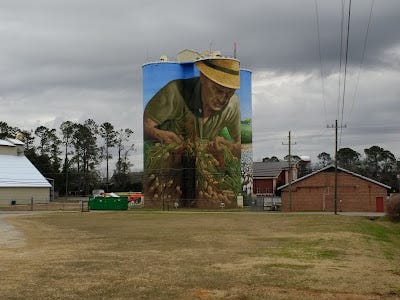
Keynote for the Building Creative Communities Conference
“Building a Compassionate Community and World”
Colquitt, Georgia, 1 February 2019
Robertson Work
NYU professor, UN consultant, author, and activist
Good morning. It is wonderful to be here with you at the beginning of this four day journey of building creative communities through story, culture, and change. It could be a whole new beginning for each of us. When I was a junior in college my life was transformed in a weekend seminar. It happens.
Wasn’t Swamp Gravy simply amazing last night? Thank you, Joy Jinks, for inviting me back to Colquitt. I first met Joy when she came to Jamaica to volunteer with an ICA community development project that I was leading. I have always been an admirer of her sparkle, intelligence, and zest for life. I also have many fond memories of the people and murals and more here in Colquitt from a few years ago. I was very worried about all of you in Colquitt during the hurricane. You are grieving. And you are rebuilding. My wife’s brother and family in Panama City are still struggling to recover. Blessings. Onward.
Let’s see who is here. From Florida/FSU? Who is studying or doing social work? Community development? Community health? Theater? I am a fan of your Emma Gonzales and David Hogg from Stoneman Douglas High School. Georgia? I am a fan of your Stacey Abrams. Elsewhere? Furthest? Closest? Youngest? Oldest?
Please relax, breath in and out, focus your gaze downward, and simply be aware of being here and now.
Please turn to a neighbor and share what you hope to achieve here by Sunday afternoon.
Let’s share a few. Anyone?
This morning I invite you to think about and discuss a true story concerning compassionate action, the crises and opportunities that we face, the principles that can guide us, the areas of transformation where we need to put our energy, and the movement of movements (MOM) that will help us create a compassionate community, America, and world. I will occasionally ask you a question; you will talk and listen to someone near you; and I will share my thoughts. This will be a dialogical-story-telling keynote, okay?
I hope that you will each think about what you will do concerning each aspect of this story. What will you study more about? How will it inform your career and life? What actions will you take now and in the future? How can you create community stories and theater around each of these issues?
First a word about compassion: it is composed of “com” (with) and “passion” (suffering): to be with suffering, another’s and one’s own. Compassionate action is not pity; it is not simply empathy. It is decisive action that I or you or someone takes to help relieve the suffering of a living being, someone else, or yourself. I believe that compassionate action is the key to the future of life on Earth.
Now a story.
It is taking place now. You and I are waking up to the realization that we live in the most critical time in all of human history. Six interconnected crises among many others face human society.
Climate change is threatening human civilization and indeed all life on Earth. Our planet is warming because of the release of carbon dioxide, methane, and other greenhouse gases from the burning of fossil fuels, the raising of animals for meat and other human activities resulting in the melting of ice caps and glaciers, sea rise, coastal flooding, forest fires, mega storms, food collapse, social dislocation, and more. Georgia and Florida have been hit hard.
The patriarchy is fighting to maintain its control of women, nature, and society. After thousands of years women are still being subjugated by men resulting in overly masculinized societies based on aggression and cut throat competition.
Greed and a rigged economy have increased income and wealth disparities with 26 people now having as much wealth as the bottom half of the global population. Billions of people live in poverty because of systems of colonialization, neocolonialization, and globalized capitalism.
The rich and their corporations are fighting to control our governments and are weakening democratic institutions in order to increase their dominance, power, and wealth.
Bias and bigotry are in full view and are asserting themselves in racism, misogyny, religious fundamentalism, homophobia, and genocide. There is widespread misunderstanding, fear and hatred of people who are of a different race, ethnicity, religion, culture, or sexual orientation.
And a culture of violence is pervasive with perpetual warfare and nuclear capability ever present. We suffer from armed conflicts between and within nations and ubiquitous violence in everyday life.
These six crises are interdependent and are demanding a whole system transformation if life on Earth is to continue and we are to thrive. What a time to be alive! This is our life.
How do these crises manifest in your community and state? Please share with your neighbor.
Fortunately we find within ourselves at least six deep, human values and principles that can provide the motivation and direction needed to confront these crises: sustainability, equality, justice, participation, tolerance, and nonviolence.
Sustainability has to do with longevity, life, and healthy ecosystems.
Equality is a sacred principle that every life is precious and deserves to
exist and to flourish.
Justice is a fierce principle of the overcoming of conditions that are unfair or harmful.
Participation is a way of enabling the voice, priorities, and wellbeing of every person in societal dialogue, policy making, and implementation.
Tolerance arises from an understanding that the multitude of unique expressions of being human are each valuable and have wisdom to share with others.
And nonviolence is a sacred choice to refrain from doing harm even while holding firmly to what is right and true. Commitment to these six principles can carry us forward in our noble quest for a compassionate society.
Which of these principles or other principles are most important to you, your life, and your work? Please share with your neighbor.
Empowered by these six principles, facing the six crises, we see at least six areas of transformation that are required of us: environmental sustainability, gender equality, socioeconomic justice, participatory governance, cultural tolerance, and peace and nonviolence.
Environmental sustainability includes the cessation of extracting and burning fossil fuels, eating less meat, protecting biodiversity of other species of animals and plants, ensuring the health of water, air, and land, the use of green energy, and mitigating and adapting to climate chaos.
Gender equality is the full partnership of women and men with the voices and wisdom of women in leadership positions at all levels of society emphasizing collaboration and caring.
Socioeconomic justice includes the provision of quality healthcare, education, and a livable income for all people.
Participatory governance is radical, direct democracy in which every person’s vote, voice, and priorities are a determining force in the political process.
Cultural tolerance includes acceptance and appreciation of differences of religion, ethnicity, race, and culture.
And nonviolence and peace mean an end to armed conflict which has lost its legitimacy as a means of dispute resolution in favor of peaceful coexistence and cooperation, and in which nonviolence becomes a way of life.
These six areas of transformation are mutually supportive in creating a compassionate community and civilization.
Turn to your neighbor and discuss which of these areas of transformation are being worked on in your community or state or needs to be worked on.
Gratefully there are millions of people engaged in mindful activism, and their organizations comprising movements that are catalyzing a better world for all. These movements include among others the environmental movement, the women’s movement, the social justice movement, the democracy movement, the human rights movement, and the peace movement. Taken together they make up a massive movement of movements or MOM that is transforming our world for the better.
The environmental movement includes organizations such as 350.org, Transition Towns, and Green Peace. Bill McKibben, Naomi Klein, and many others are part of this.
For example, sixteen year old Greta Thunberg from Sweden is providing fierce climate leadership. She began reading about climate change when she was eight. She became depressed and stayed home for a while. Her mother is an opera singer and her actor father stayed home with her. She convinced her parents to stop eating meat and to stop traveling by jet. She started a strike and was invited to speak at the UN Climate Summit in Poland. Recently she told business leaders and politicians in Davos at the Global Economic Forum: “I don’t want you to be hopeful. I want you to panic. I want you to feel the fear I feel every day. And then I want you to act. I want you to act as you would in a crisis. I want you to act as if our house is on fire. Because it is.” “We can’t save the world by playing by the rules because the rules have to be changed. Everything needs to change and it has to start today.” Greta says that having Aspergers actually helps her to focus and stay committed. Tens of thousands of students around the world are now striking and marching for action on climate chaos mitigation.
The women’s movement is made up of many organizations such as NOW and Women for Justice.
The social justice movement includes organizations such as labor unions.
The democracy movement includes organizations such as Indivisible, Our Revolution, MoveOn, Democracy Now, and Democracy Spring. We have people in Congress like Rep. Alexandria Ocasio-Cortez and Senator Elizabeth Warren who are helping lead in this movement.
The human rights movements includes organizations such as the ACLU, LGBTQ rights organizations, and Human Rights Watch.
And the peace movement includes many organizations that promote nonviolence, and disarmament, and call for an end to the use of armed conflict.
When these six movements and many others work together they become an unstoppable movement of movements or MOM.
One example of MOM is The Poor Peoples’ Campaign continuing in the footsteps of the Rev. Dr. Martin Luther King Jr. which is focusing on poverty, racism, climate change, and militarism: The founder of this current manifestation, the Rev. Dr. William Barber II has said: "Jesus, a brown-skinned Palestinian Jew, called us to preach good news to the poor, the broken, the bruised, and all those who are made to feel unaccepted...We must shock this nation with the power of love. We must shock this nation with power of mercy. We must shock this nation and fight for justice for all!"
Two other examples of MOM are the Green New Deal focusing on climate change mitigation, jobs, and democratic socialism, and Charter for Compassionate International encompassing all the movements.
People everywhere are waking up and standing up. We are on a journey of realizing a compassionate civilization community by community, organization by organization, and person by person. However, it is only ensured by what you and I and 7.3 billion people do each day
Turn to your neighbor and discuss which of these or other organizations or movements are working in your community or state, what they are doing and where you see collaboration of different organizations and movements.
In each of these six movements, we need to identify and articulate a hoped-for future vision, the obstacles blocking that vision, strategic directions that will overcome the obstacles and move toward the vision, and the action plan and timeline that will achieve the strategies. This facilitated strategic planning process is part of the ICA’s Technology of Participation (ToP).
One of the global programs I managed at UNDP was on Decentralizing the MDGs (the precursor of the SDGs) through Innovative Leadership including the use of ToP, integral thinking that changes mindsets, behaviors, cultures, and systems, and social artistry involving sensory, psychological, mythic, and unitive dimensions of social change, all of which you will be experiencing and learning during this conference. I taught these innovative leadership methods in my NYU Wagner graduate courses.
I find that I must take good care of myself so that I can continue the journey of care for all beings everywhere. I am in my 50th year of being a global-local citizen and servant leader and am still passionate about my life of service. In my workshop tomorrow afternoon I will share my life story of community, organizational, and leadership development and help you dream your own life story. Every day I find ways to cultivate understanding and compassion, realize happiness, celebrate gratitude, live lifelong commitment, choose courage again and again, dance with time, and embrace sadness, sickness, old age, and death. I meditate daily, keep a journal, get enough sleep, eat wholesome food, spend time with family, walk in nature, exercise at the gym, read, write, speak, consult, teach, and engage in social and political activism.
How do you take care of yourself for this life-long journey of care? How do you care for others on the journey? Please share with your neighbor.
What would you name this story? Share with your neighbor.
Let’s hear a few names.
Let’s continue our journeys of compassionate action for the rest of our lives. Yes! Let’s continue to build Colquitt, and other communities as compassionate, and sustainable to show all the communities of Georgia, Florida, the USA, and the world what it looks like. Onward! And don’t forget to vote and get out the vote in 2020, a very, very important election. Let’s shock the world with sustainable, just, compassionate development!
Thank you for your participation and wisdom during this interactive keynote, and for your full and deep lives of service. This keynote story is based on my book A Compassionate Civilization: The Urgency of Sustainable Development and Mindful Activism.
Let’s end our interactive keynote by moving into action with our bodies. Please stand up. Let’s sway. Let’s dance. Hold hands. Raise your arms. Yes, we can!
Photo: Colquitt, Georgia, home of Swamp Gravy